How To Change A Bad Habit
By Alan Roark, Vault Coach, Amherst Steele H.S., Amherst, Ohio
One of the things we do as coaches is to improve the performance of our athletes by helping them fix and replace “bad habits” with the proper techniques or “good habits”. I’ve developed a model that works for me to fix bad habits really fast. Sometimes I can fix something in a single practice. See the following model and the explanation of each step below.
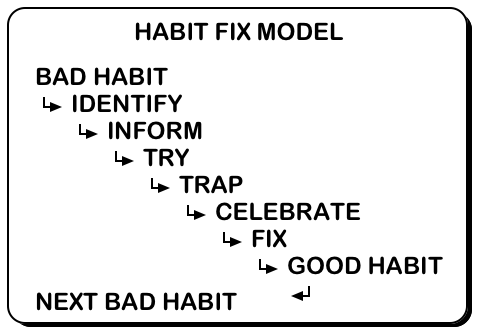
First, you as a coach should watch videos, attend clinics, read books, talk to other coaches, and get yourself informed about what good vaulting looks like and what makes it work. If you the coach don’t know, it’s hard to recognize and fix bad habits.
BAD HABIT
I never tell the vaulter something they’re doing is a bad habit. I don’t give it any credit or recognition. (Whatever you praise stays around) I just note to myself what I want to fix. If I tell the vaulter we’re going to fix a bad habit they have, I get a lot more resistance to the fix.
IDENTIFY
What I do is simply identify what they are doing and ask them if they’d like to learn a better, more fun way of doing that particular part of the vault. When they say, yes, they give me permission to tell them my idea and the fix proceeds much faster than if I try to force them to change. I’m always looking for cooperative learning. It’s way easier and faster to accomplish new skills.
INFORM
Here’s where I just tell them what I see them doing and then offer the better, more fun, way to do that part of the vault. For example if they’re swinging their trail leg with a bent leg, I’ll just say, I’ve noticed that you swing your trail leg with a bent knee, did you know that if you lead with your toe, your leg will straighten and you’ll get a lot more zing and lift and it’ll be a lot more fun when you swing it straight instead of the way you’re doing it now. It’ll be really sweet when you get the zing of a straight leg. Wanna try it?”
TRY
Now, I just have them try the new idea. If I’ve sold it in a fun, positive way, and they understand what the difference is, trying it may be all you need to do to fix the old bad habit. It can happen that easy. If it doesn’t work to try it several times, I’ll go to the next step and try to trap them into doing it right.
TRAP
In the leg swing example, I have several drills to help them feel the power of a good trail leg or I’ll put a towel in a clump at the top of the slope of the pit and have them try to kick it with their toe, or I make some sort of game up to try to trap them in the proper technique. One of my vaulters is a big video gamer and lots of time with him I’ll tell him where the imaginary contacts are to get big points in the “vault game” and sure enough, he’ll try to “hit” the contacts with his toe the next time he vaults. I’ll make up games, do drills, relate it to other sports they do, or say it a different way to try to trap them into the correct technique.
CELEBRATE
As soon as they get all or any part of it right, I start celebrating. I’ll say, “wow, did you feel how much better that works? Wasn’t that a lot more fun? Man, you looked really cool doing it that way! Do it again, that was sweet!” I try to give lots of power and recognition to the new, better way. I believe that all habits are a result of their brain thinking it’s the best way to do something and get through it without getting hurt. If I can get their brain to accept the new technique change as more fun, better, safer, it will simply replace the bad habit and become the new normal thing to do.
FIX
As soon a part of the new technique is working I go into more details and try to get the whole fix to fall into place. It usually works pretty quickly.
GOOD HABIT
Now we repeat the new habit enough that it becomes normal and the fix is complete. We now have a good habit that they accept as safe.
NEXT BAD HABIT
Look for the next thing that they’re doing that needs to be fixed.
Note: I never, ever, ever tell a kid that it will take a long time to fix something they’re doing. They might believe me! Every kid is different, every challenge is different, and you as a coach don’t know how long it will take to fix. I’ve had kids take a year to go up 6 inches and I’ve had kids go up 3 feet in one practice. If they finally “get it” on a couple parts of the vault, big improvements can happen fast. Don’t ever set in their mind that it will take a long time to learn something. Kids today are extremely fast learners. Especially the ones that play video games a lot. Their ability to take in and process information is amazing. This winter, I worked with a junior girl from another school who had a stutter step in her approach since 7th grade. I fixed it in 20 minutes.
Note: Stay positive and up-beat. I believe that yelling at them only makes the stress go up and the learning slow down. All of you football/ vault coaches relax and enjoy the lighter, more fun, world of track and leave the yelling and demanding on the football field. This is a place to hone your technique coaching skills with unique individuals trying a unique and really challenging sport.
Note: I always try to emphasize how it “feels”. If they can “feel” how much better the new way is, they will get back to it way faster and be able to make it the new habit. “Feel” is something they can repeat faster and more often than just “knowing” how it’s supposed to work. I’ll say, “wow